
Skip to main contentSkip to navigation
    Responsible AI

    Responsible AI for Care Coordination

    AI should create measurable value in the real workflows that shape care delivery. At Medi-Aide, we embed it into recruitment, operations, coordination, and workforce wellbeing — practical, governed, and designed for real-world use.

    Explore the pillars

    Designed alongside Canadian care operators, caregivers, and families. Bounded, reviewable, and accountable by design.

    Care coordinator reviewing AI-suggested staffing recommendations alongside the underlying inputs on a Medi-Aide dashboard

    We are not building AI as a disconnected demonstration.

    We are embedding it into the platform in ways that are practical, governed, and designed for real-world use — supporting the operational, workforce, and coordination challenges agencies face every day.

    That spans recruitment and onboarding, staffing, scheduling, caregiver support, patient coordination, family communication, operational review, and workforce wellbeing.

    Recruitment & workforce growth

    Recruitment intelligence and workforce growth

    Recruitment is one of the most important drivers of care continuity. When agencies recruit, screen, onboard, and retain caregivers more effectively, the impact is felt across the entire care network.

    Medi-Aide applies AI across the caregiver hiring journey — talent pipelines, job boards, applications, interview scheduling, onboarding, referrals, screening, document requests, hiring pages, and recruitment analytics — with agency-level controls so it remains configurable and accountable in practice.

    • Application summaries and pre-screening assistance
    • Outreach drafting and recruiter suggestions
    • Funnel insights and interview preparation
    • Agency-level toggles, usage tracking, kill-switches
    Operational decision support

    Agency AI Agents for operational decision support

    Our Agency AI Agents are designed to support operational workflows where speed, context, and oversight all matter — staffing recommendations, shift support, visit verification triage, operational review, and flagged workflow items.

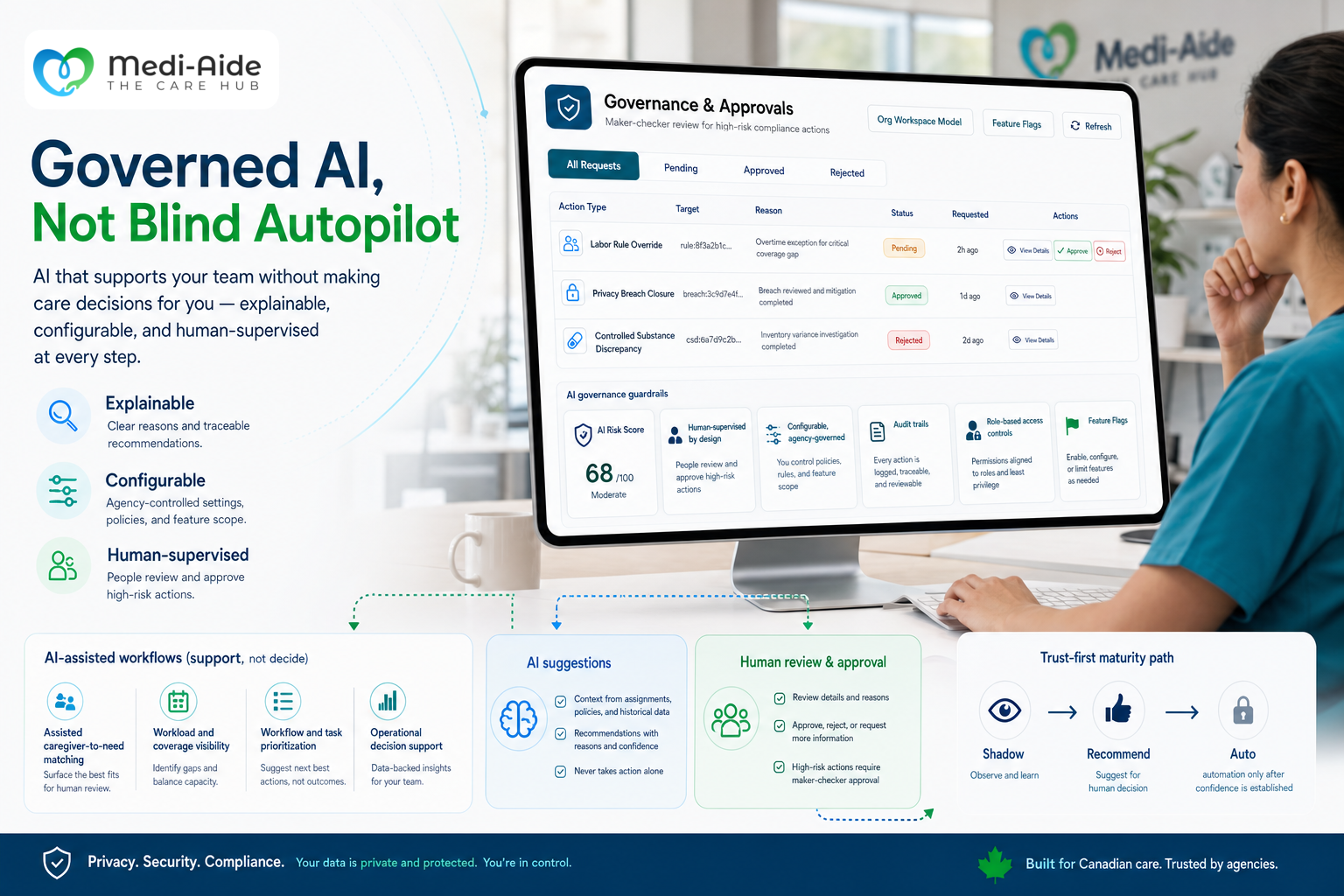
    They are not designed to act without constraints. They operate within human-gated workflows that include approval paths, audit trails, shadow validation, and controlled automation — helping teams make faster, better-informed decisions while preserving accountability for actions that affect care delivery.

    • Human-gated approval paths and audit trails
    • Shadow validation before wider operational use
    • Controlled automation scoped to enabled modules
    • Accountability preserved for care-impacting actions
    Contextual assistance

    Medi-Agent for contextual assistance

    Medi-Agent is our assistant layer for contextual guidance and workflow support. It combines conversational assistance, contextual retrieval, and governed actions to help users navigate complex tasks more effectively.

    In care coordination, users do not only need answers — they need structured follow-through they can trust. Medi-Agent provides role-aware guidance, care-plan support, reviewable suggestions, approvals, and action flows designed with rollback awareness.

    • Role-aware guidance and care-plan support
    • Reviewable suggestions and approvals
    • Action flows with rollback awareness
    • Scoped to the agency workspace and access controls
    Matching & scheduling

    Matching and scheduling intelligence

    Medi-Aide applies AI to matching and scheduling workflows where multiple variables must be balanced at once — caregiver matching, candidate scoring, staffing recommendations, preference-aware assignment logic, workload balancing, and scheduling support.

    In selected workflows, shadow-mode comparison can be used to evaluate AI recommendations against human decisions before wider operational use. The purpose is not to replace schedulers or coordinators — it is to provide stronger signal in environments where coverage, skills, availability, location, preferences, and continuity all matter simultaneously.

    • Caregiver matching and candidate scoring
    • Preference-aware assignment and workload balancing
    • Staffing recommendations and scheduling support
    • Shadow-mode comparison against human decisions
    Caregiver wellbeing

    WellArc™ — caregiver wellbeing intelligence

    WellArc™ is intentionally different from a general assistant or open-ended agent. It is a bounded wellbeing intelligence layer designed to help organizations better understand caregiver wellness and recommend appropriate next steps.

    WellArc™ brings together structured inputs — check-ins, wellness assessments, intervention history, workload pressure, and scoring logic — to provide a more explainable view of caregiver wellbeing. In a trust-sensitive environment, bounded intelligence is a strength.

    • Opt-in caregiver check-ins and wellness inputs
    • Workload pressure and intervention history
    • Explainable scoring and reviewability
    • Routes to support workflows, not automated decisions
    Practical AI across the platform

    Practical AI across the platform

    Not every valuable AI capability needs to be agentic. Across Medi-Aide, AI is also applied in practical ways — summarization, anomaly detection, transcription, document and compliance review support, care-plan suggestions, analytics insights, and operational recommendations.

    We believe the future of AI in care coordination is not a single model doing everything. It is the right AI pattern applied to the right operational problem, with the right safeguards in place.

    • Long-form note and document summarization
    • Anomaly detection on operational data
    • Transcription and compliance review support
    • Analytics insights and operational recommendations
    Governance by design

    Governance is built into the design — not added after.

    Governance is central to how we build AI at Medi-Aide. AI-generated drafts are reviewable. Sensitive inputs are protected. Safety checks flag overreach. Agencies can control or disable AI features. Operational agents remain human-gated. Audit trails and accountability are treated as product requirements, not afterthoughts.

    Read the Responsible AI policy
    • AI-generated drafts are reviewable
    • Sensitive inputs are protected
    • Safety checks flag overreach
    • Agencies can disable AI features by module
    • Operational agents remain human-gated
    • Audit trails are treated as product requirements

    The value across the care ecosystem

    When AI is built responsibly, its value extends across the full care network — not just one team.

    For agencies

    Improved recruitment, staffing, scheduling, onboarding, compliance support, and operational decision-making — without giving up oversight.

    For caregivers

    Reduced administrative burden, support for career growth, improved onboarding experiences, and earlier wellbeing intervention.

    For patients and families

    Clearer support pathways, more responsive care experiences, and stronger continuity across the care journey.

    Intelligence should not replace the people who deliver care.

    At Medi-Aide, our approach to AI is grounded in a simple principle: it should strengthen the systems around the people who deliver and coordinate care.

    Ready to see how Medi-Aide fits your agency?

    Book a guided discovery session and we will map your current workflows, identify operational gaps, and show the Medi-Aide modules most relevant to your agency.

    Contact Us